
National Trust Database - Search Results |
Back to search page » | |
| Displaying 1- 10 of >200 records found |
| Image | Name | Detail | File number | Level |
|---|---|---|---|---|
|
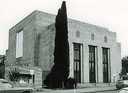
Second Church Of Christ Scientist & Hill, Norman & Beard Pipe Organ
41 Cookson Street,, CAMBERWELL VIC 3124 - Property No B4985 |
An austere brick building of monumental proportions, designed by Bates Smart & McCutcheon and built in 1937, comprising a church, Sunday school and offices at various levels. The exterior consisits of overlapping cuboids of banded cream brickwork with patterned cornices and three large wrought iron entrance doors. The church interior, with louvered ceiling, focusses upon a large rostrum screen with geometric patterns. This building is of importance as a distinctive local ... more |
B4985 |
State |
|
63 Farnham Street,, FLEMINGTON VIC 3031 - Property No B5343 |
B5343 |
File only | |
|
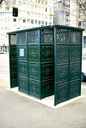
Cast Iron Urinal - Group Classification
Cnr Flinders & Exhibition Streets,, MELBOURNE VIC 3000 - Property No B6880 |
Group Statement of Significance: Melbourne's cast iron public urinals have national historic, technological, aesthetic and social significance. They are the survivors of a group of about 40 structures erected between c.1903 and 1918, and connected to the new underground sewerage system. Cast by C. Monteath & Sons, Ironfounders of South Melbourne, they employed a prefabricated interlocking post and panel system which enabled the urinals to be assembled on site, or dismantled ... more |
B6880 |
National |
|
Chemistry Building - University Of Melbourne
Masson Road,, PARKVILLE VIC 3010 - Property No B6755 |
The Chemistry Building is of state historical and architectural significance as a distinctive modern interpretation of a collegiate Gothic style. The building was designed in the modern Gothic style by Percy Everett in 1938. Its cream brickwork, bold massing and tower decoration are notable. The Chemistry Building forms part of a major phase of expansion at the University in the 1920's and 1930's. It also demonstrates the importance given by the university to the opinions of a ... more |
B6755 |
State | |
|
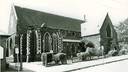
Former St Mary's Church of England & Organ
St Mary's Anglican Church
163 Howard Street,, NORTH MELBOURNE VIC 3051 - Property No B1899 |
Church Statement of Significance: Lloyd Tayler's earliest work, built in 1860-62 with extensions in 1868. The austere and expansive interior is well planned and culminates in a distinctive vaulted crossing. Timber ceilings in nave, transepts and chancel are notable. Classified: 'Local' 26/08/1965 Revised: 'Regional' 16/04/1970 Revised: 03/08/1998 Organ Statement of Significance: A two-manual organ of 12 stops built in 1958 by the German firm of Werner Bosch for a ... more |
B1899 |
State |
|
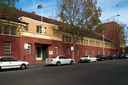
Former Royal Australian Army Medical Corps Training Depot
RHSV
249 A'Beckett Street,, MELBOURNE VIC 3000 - Property No B6139 |
Built in 1938 for the Army Medical Corps, this drill hall and offices is a superior and intact example from a distinctive public building design-type which successfully combined the prevailing Moderne influences with the formal classical revival solemniity desired for public architecture. It is also symbolic of a development of a continuing use-type (drill halls), reflecting a re-interpretation of what had been hitherto an almost sterotyped design response to the type and a ... more |
B6139 |
State |
|
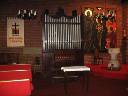
St George's Anglican Church & Robert MacKenzie Pipe Organ
55 Lucknow Street, TRAVANCORE VIC 3032 - Property No B2890 |
Church Statement: An architecturally remarkable, if not wholly felicitous church-cum-hall built in 1925-6 to the design of Louis Williams. It is distinguished externally by the jerkin-head gable projecting over the bell and by the rectilinear fenestration below. Internally the hammer-beam trusses and exposed brickwork evoke the English Arts & Crafts while the extraordinary form of the pew-ends gives them the appearance of teetering over backwards. Classified ... more |
B2890 |
Regional |
|
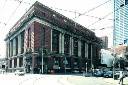
General Post Office & Parcels Post Building
Mail Exchange Building
670 - 696 Bourke Street,, MELBOURNE VIC 3000 - Property No B3399 |
Built during 1913-17 to the design of the office of the Commonwealth Home Affairs under Chief Architect, Horace J Mackennal, the seven storey steel-framed Mail Exchange Building is architecturally significant at the state level as an impressive example of the conservative classical design by the youthful Commonwealth government and in being distinguished by its Greek flavour, ten years ahead of Melbourne's mainstream Modern Greek Revival. Its architectural significance is enhanced ... more |
B3399 |
Regional |
|
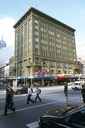
349 - 357 Bourke Street,, MELBOURNE VIC 3000 - Property No B6561 |
A reinforced concrete and steel emporium built to the then Melbourne height limit of 132 feet (40 metres) the London Stores was built in 1925 to a design by the architects H W and F B Tompkins. The building is in the same tradition of cubic classical revival forms expressed by others such as the Nicholas and Port Authority buildings, is one of the major emporiums built in Bourke Street in the period 1910-30 and is a significant landmark marking, together with the Post Office, the ... more |
B6561 |
Regional |
|
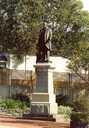
Margaret Baskerville - Thomas Bent Statue
Cnr Nepean Highway & Bay Street,, BRIGHTON VIC 3186 - Property No B6674 |
The statue is of Sir Thomas Bent (1838-1909), prominent Brighton politician and former Premier of Victoria (1904-1909). The large bronze figure is mounted on a tall granite plinth and is currently located beside a busy intersection on one of Melbourne's major highways, centrally situated in Bent's former Parliamentary constituency. The statue of Sir Thomas Bent, unveiled in 1913, is significant for historic and social reasons at a State level. The Statue is significant for ... more |
B6674 |
State |
| 1 2 3 ... 20 | next |
